


Introduction
When a life-altering medical prognosis arrives, your executive brain gets hit with a tsunami of clinical noise, contradictory health advice, and administrative chaos.
Trying to process every option through raw working memory leads straight to decision fatigue and sympathetic nervous system overdrive. This week in the ReadersKey Research Edition,, we explore the clinical neuroscience of visual decision models, like The Alignment Codex and Alignment Compass to examine how externalising mental processing reduces cognitive load to help restore autonomic recovery.
Decoding: The Cognitive Drain of Medical Overwhelm
The room grows quiet after the doctor speaks, but inside your head, the noise spikes. A fresh diagnosis of Coronary Artery Disease, Cerebral Small Vessel Disease, or any complex condition doesn’t just challenge your physical vessel; it overloads your prefrontal cortex.
You wake up at 3:00 AM, pacing the floor, caught in an endless loop of searching for answers across medical journals, online forums, and stack after stack of clinical pamphlets.
This mental paralysis is not a lack of self-discipline, it is state-level decision fatigue.
In clinical research, decision fatigue describes a state of impaired self-control leading to maladaptive decision-making, which directly undermines a patient’s ability to self-manage chronic conditions (Pignatiello et al., 2018; Pignatiello & Hickman, 2018). Existing self-management theories often fail because they ignore this limited decision-making capacity, leaving patients vulnerable to either impulsive choices or complete decision avoidance (Pignatiello et al., 2018; Pignatiello & Hickman, 2018).
When you force working memory to hold, evaluate, and prioritize endless health variables at once, your brain interprets the ambiguity as an active threat.
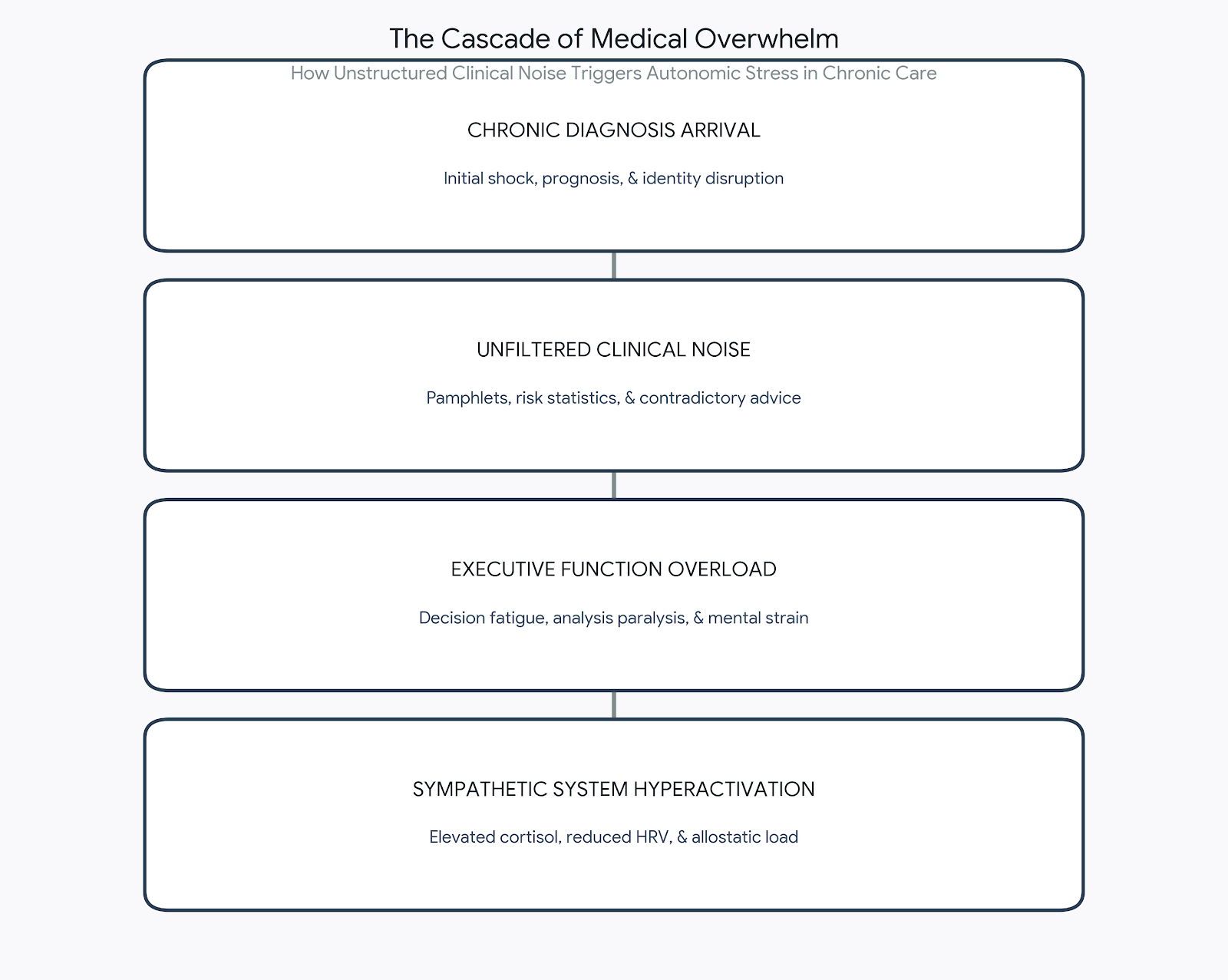
This continuous cognitive strain keeps your nervous system locked in a stress loop.
Emotional regulation struggles, combined with fatigue, directly impair working memory, while attempts at expressive suppression increase extraneous cognitive load (Pignatiello & Hickman, 2018). Trying to design a five-year master plan while running on cognitive burnout is a biological trap. You don’t need more raw information; you need a structure that lowers cognitive load.
Come on over to the Alignment Campus at formulaforlife.ai, as a Voyager (paid) subscriber you already have free access.
