


Standing at the Fault Line of Diagnosis
A chronic diagnosis alters reality overnight. One afternoon you are navigating your career, family, and future; the next, a clinical label partitions your life into a distinct before and after (Cobbin, 2025). For those living with cardiovascular conditions or complex comorbidities, that initial shift brings a heavy quiet (Cobbin, 2025). You are handed test results, prescriptions, and prognosis stats, yet the underlying biological storm remains unaddressed (Cobbin, 2025).
The immediate temptation is to withdraw into passive survival, accepting the label of a “patient” waiting for external interventions (Cobbin, 2025). Yet deep down, you know that managing a chronic condition requires more than clinical compliance (Cobbin, 2025). It demands an active reclaiming of your health, your identity, and your daily choices (Cobbin, 2025).
The Silent Strain of Suppression and Dysregulation
The core issue facing many Titans isn’t just the physical pathology; it is the unaddressed internal forces that accelerate disease (Cobbin, 2025). When faced with chronic stress, conflict, or high-pressure environments, a common instinct is to internalize anger, shove down anxiety, and project stoicism (Speyers, SFE29 interview, 2026).
This emotional suppression comes at a steep physiological cost:
Elevated Cardiovascular Strain: Suppressing emotional expression triggers acute sympathetic reactivity (Tyra et al., 2023). Quantitative reviews demonstrate that emotional suppression significantly increases cardiovascular strain and acute physiological reactivity, elevating blood pressure and heart rate during stress exposure (Tyra et al., 2023).
Long-Term Disease Progression: Studies examining life-course stress exposure show a direct link between internalized emotional distress and systemic physiological dysregulation (Pu & Kong, 2026). Over time, this unexpressed strain correlates with elevated chronic disease severity and vascular strain across the life course (Pu & Kong, 2026).
The Exhaustion Loop: Trapped in a heightened “fight, flight, freeze, or fawn” state, the autonomic nervous system remains chronically dysregulated, draining mental bandwidth, ruining sleep, and compounding physical fatigue (Speyers, SFE29 interview, 2026).
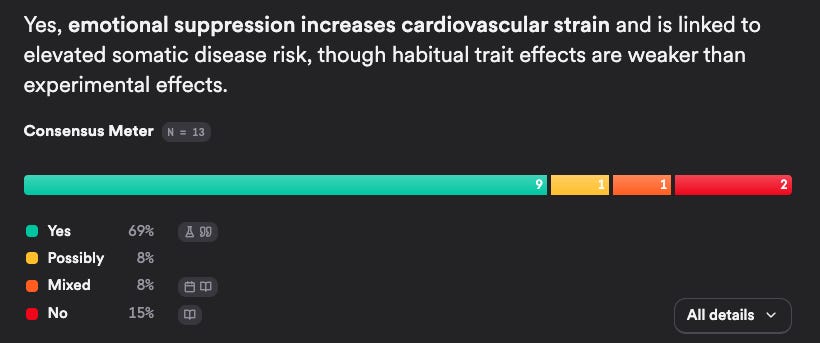
Consensus app — “Does emotional suppression increase cardiovascular strain?” N = 13 studies.

Kerri Speyers and Functional Intelligence
Into this internal storm steps Kerri Speyers, an emotional intelligence coach with two decades of medical industry experience (Speyers, SFE29 interview, 2026). Kerri doesn’t offer superficial positivity or vague wellness advice (Speyers, SFE29 interview, 2026). Instead, she brings grounded, functional intelligence, treating emotions not as flaws or weaknesses, but as vital biological information (Speyers, SFE29 interview, 2026).
